


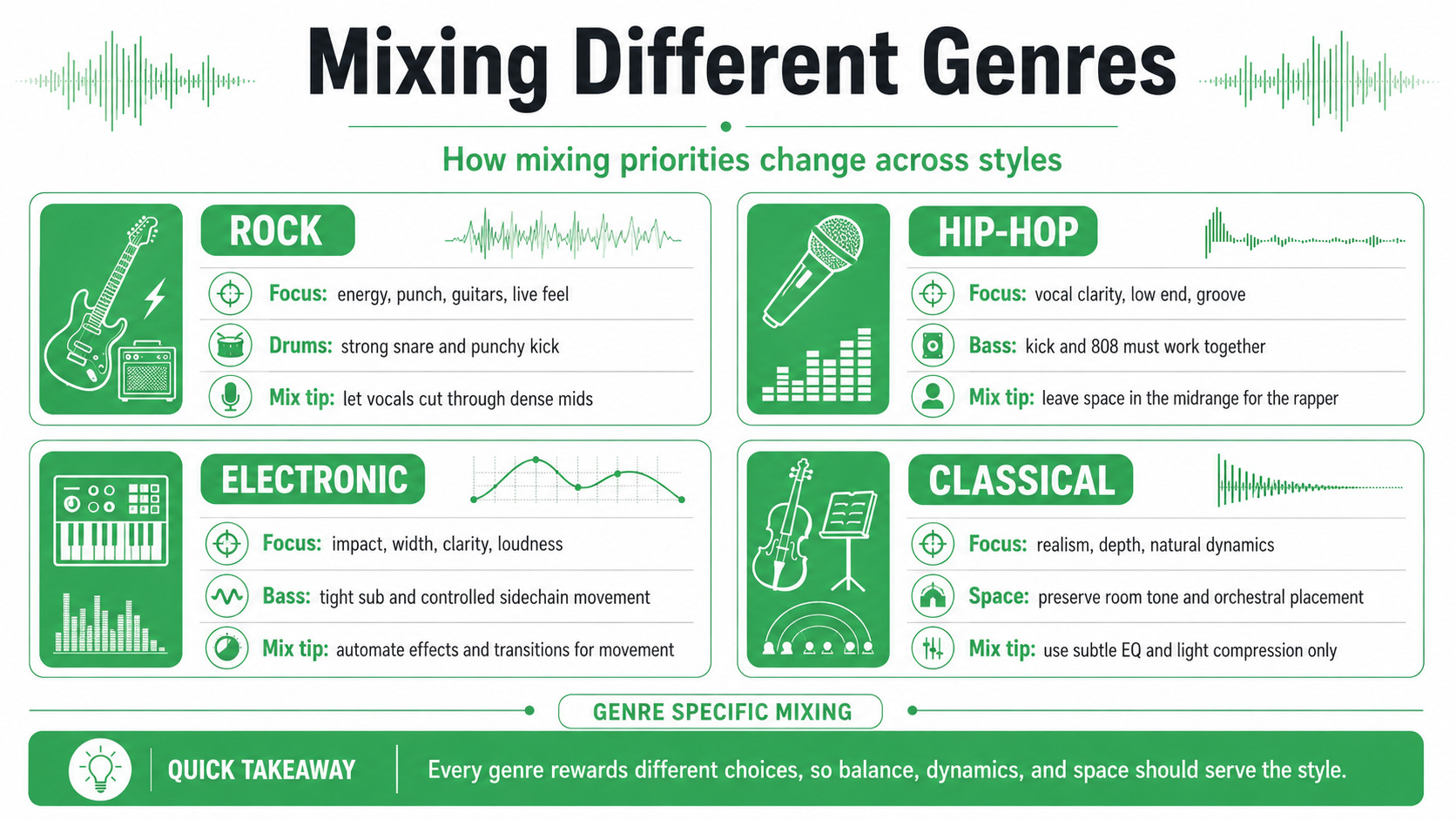
Mixing Different Genres is not about buying a new plugin for every style. It is about changing your priorities. A rock mix usually wants punch, attitude, and width. A hip-hop mix often lives or dies on kick, bass, and vocal authority. Electronic tracks can demand surgical low-end control and obvious movement. Classical music usually asks for the opposite of modern pop habits: less hype, more realism, more dynamic range, and more respect for the natural space. In other words, the tools stay familiar, but the way you use them shifts with the music.
Table of Contents
- Why mixing different genres needs a different mindset
- Start simple before you do Genre Specific Mixing
- Genre specific mixing for rock
- Genre specific mixing for hip-hop and electronic music
- Genre specific mixing for classical and acoustic-first music
- How EQ, compression, reverb, stereo width, and loudness change across genres
- Common mistakes when mixing different genres
- Final thoughts on mixing different genres
Why mixing different genres needs a different mindset
The quickest way to ruin a mix is to assume that every genre wants the same finish. It does not. Listeners expect different balances of volume, depth, stereo width, attack, and compression, even before they realize they expect them. Rock fans usually forgive some grit if the mix feels exciting. Electronic listeners often want clarity in the sub and movement around the kick. Classical listeners will notice quickly if the room feels fake or the dynamics feel crushed. That is the heart of Genre Specific Mixing: the same technical foundation, but a different end goal.
What stays the same in every mix
No matter the style, mixing still comes down to balancing levels, panning, frequency content, dynamics, and depth. That is still the right starting point. Before you worry about “rock EQ” or “EDM compression,” you need to decide what matters most, what belongs in the center, what can sit toward the sides, and what should feel near or far.
When mixing different genres you do not need different plugins. You need different priorities.
That idea sounds simple, but it changes everything. A plate reverb is not automatically “for rock,” and a hall is not automatically “for classical.” A compressor is not “for hip-hop” and unsuitable for orchestra. The question is always: what story is the music trying to tell, and what does the audience expect to hear first? That mindset keeps you from mixing by habit instead of by intention.
Start simple before you do Genre Specific Mixing
The funny thing about advanced mixing is that it usually starts with boring basics. It is better to begin with a rough mix using just faders and pan controls, then group related tracks into buses. This is not only beginner advice. It stays useful when your sessions become large and complicated. If the song does not make sense with volume and panning alone, more processing will usually make it messier, not better.
Build a Static Mix before touching the “fun” stuff
A static mix tells you what the music naturally wants. Pull the drums, bass, vocals, guitars, synths, or strings into place before you start carving frequency holes everywhere. Heavier, bassier sounds usually fit best in the center, while less critical bright elements can live more comfortably toward the sides.
That becomes especially useful when you mixing different genres. Center information means different things in different styles, but the core principle still holds: the most important elements need a stable position from which the rest of the arrangement can grow.
A practical workflow that works in almost any genre
This quick workflow is simple on purpose, because simple workflows survive real sessions:
- Get the rough balance with faders only.
- Pan obvious center elements first: lead vocal, kick, bass, and usually snare.
- Create buses for drums, guitars, synths, backing vocals, and effects.
- Decide what the emotional focus is in each song section.
- Then start using EQ, compression, automation, and ambience.
This workflow also helps fight one of the biggest beginner mistakes: soloing tracks too much. A kick drum can sound strange on its own and still be perfect in the song. Mixing in solo can become your worst enemy because the real job is not to make isolated sounds impressive. The job is to make the whole song work.
Use references, but do not copy them blindly
Reference tracks are useful because they show you where a genre usually places its energy. However, they become dangerous when you copy tonal moves without checking whether your arrangement matches.
A sparse folk-rock track and a wall-of-guitars rock chorus should not receive the same EQ treatment. A boom-bap hip-hop beat and a festival EDM drop should not use the same sidechain depth. Genre references are a compass, not a stencil. That is especially true because arrangement density directly affects masking, dynamics, and perceived loudness.
Genre specific mixing for rock
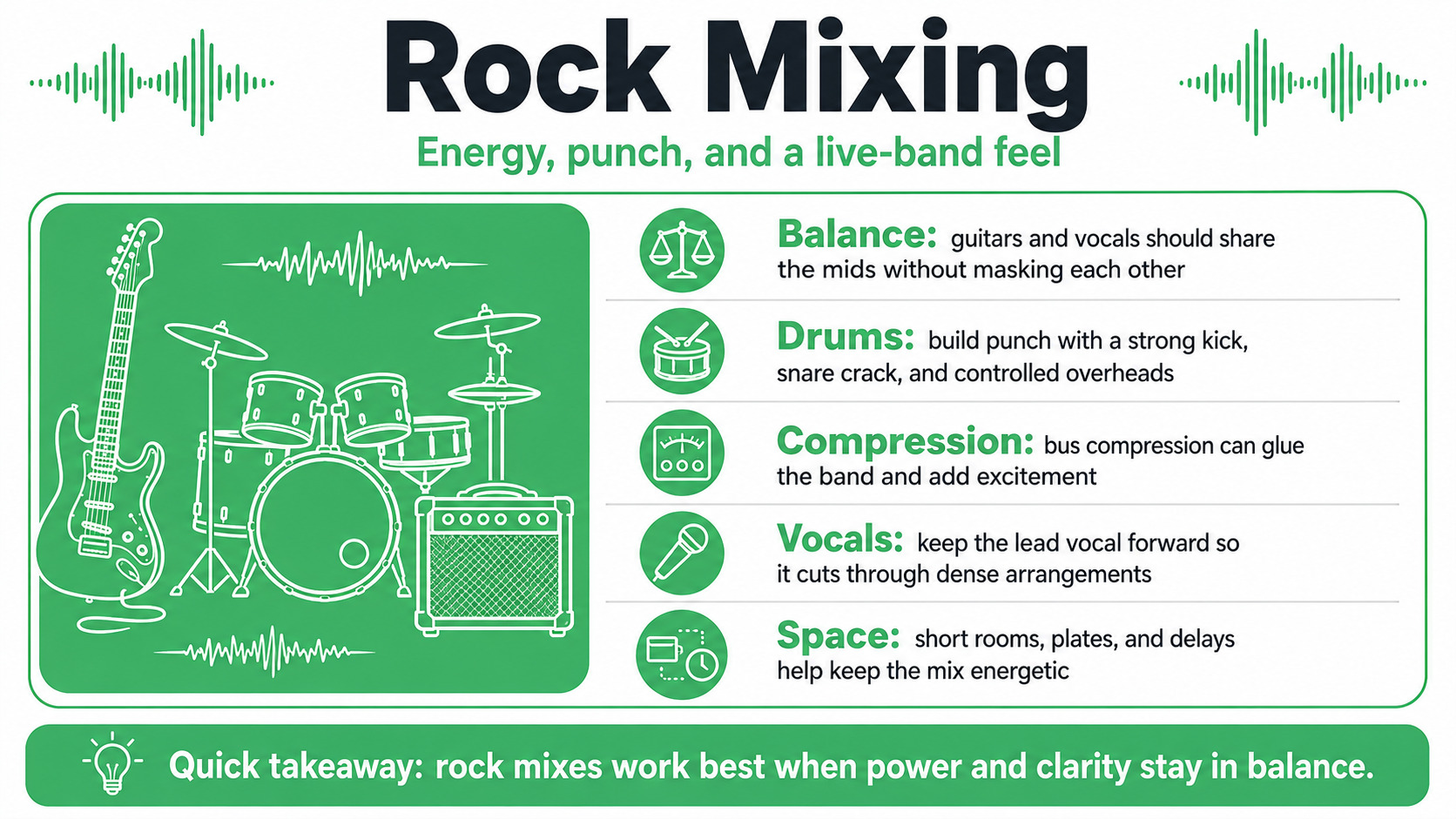
Rock mixes usually feel best when the rhythm section is solid, the vocal feels believable, and the guitars add width without swallowing everything else. A practical way to build the mix is to establish the drums, bass, and lead vocal first. Once that central foundation works, you can position the guitars around it.
Think of it as building the spine before spreading the shoulders. The drums and bass create momentum, the vocal communicates the message, and the guitars provide size, texture, and attitude.
What usually matters most in rock
In rock, drums and bass often provide the push, while guitars create size and excitement. That does not mean the guitars should dominate all the time. If the guitars are wide and dense, you often need to protect the snare crack and the vocal midrange on purpose.
A snare with too much high-frequency attack can still disappear once several distorted guitars enter the arrangement. This is a useful reminder that “more attack” does not always mean “more punch.” Sometimes rock punch comes from controlled mids, a strong fundamental, and enough space around the transient.
Double-tracked rhythm guitars are still a classic rock technique for a reason. Placing separate performances on opposite sides can create natural width without relying on artificial stereo processing. If your chorus feels small, do not immediately reach for a stereo widener. First ask whether the arrangement needs another real guitar performance or a more intentional contrast between the left and right sides.
Rock move examples that actually help
A few rock-friendly moves tend to work well as starting points:
- Keep kick, bass, snare, and lead vocal stable and central.
- Let rhythm guitars create width, often through complementary left-right placements.
- Use bus compression gently for glue, not to flatten the band.
- If the vocal is fighting guitars, try cutting guitars in the vocal presence range instead of boosting the vocal repeatedly.
A rock-specific reverb trick is to think in layers rather than using one large wash. Short ambiences can give drums and guitars a believable room, while a plate or delay can help the lead vocal stay exciting without pushing it too far back.
A small amount of pre-delay creates a gap between the dry source and the beginning of the reverb. That gap can preserve the initial impact of a snare, guitar, or vocal while still allowing the reverb tail to add size and character.
Where beginners go wrong in rock
The big rock mistake is chasing “big” by stacking too much of everything at once. Too much low-mid guitar makes the mix feel smaller rather than larger. Too much room on the drums blurs the groove. Too much master bus compression kills the lift of the chorus. Too much hard panning without center support makes the mix feel hollow in mono.
Rock likes energy, but it still needs a strong center, sensible phase relationships, and enough contrast between sections. A chorus will not feel huge if the verse already contains every layer at full volume and full width.
Genre specific mixing for hip-hop and electronic music
Hip-hop and electronic music get grouped together frequently, but they are not the same mixing problem. They do share a few important priorities: low-end clarity, rhythm impact, and a front-facing sense of control.
A kick-triggered sidechain can temporarily reduce another element whenever the kick hits. This gives the kick a brief opening in the mix without requiring a permanent EQ cut. Depending on the attack, release, and gain reduction, the result can be almost invisible or become an obvious rhythmic pumping effect.
Hip-hop mixing is often about authority
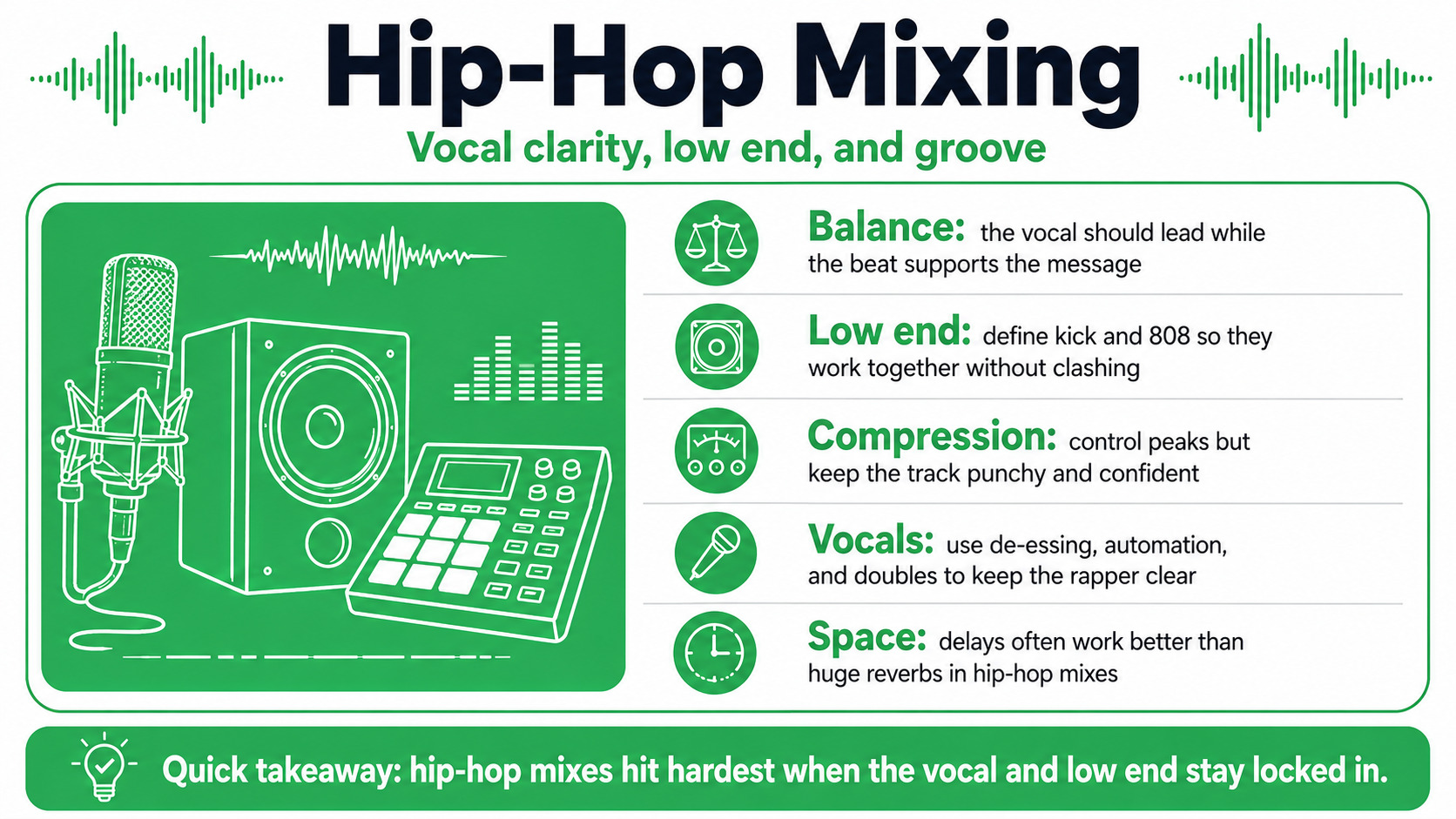
A lot of hip-hop mixing is about making the beat hit while keeping the vocal believable and close. The kick-and-bass relationship matters a ton, but so does vocal consistency.
Moderate compression can help stabilize a rap vocal, but the release should still respond musically to the delivery. A fast, dense verse may need different timing from a slower melodic hook. The more aggressive the performance, the more firmly you may control the peaks, but intelligibility should remain the first goal.
Kick and bass masking is one of the classic hip-hop headaches. These two elements can easily obscure each other in the low end. If your 808 vanishes whenever the kick lands, do not simply turn both of them up. Choose a leader. Let one own the deepest impact, while the other speaks slightly higher or occupies a different moment in time.
Hip-hop move examples
Here are some starting points that make sense in hip-hop sessions:
- Choose whether the kick or the 808/bass owns the deepest part of the spectrum.
- Use small EQ cuts before extreme boosts, especially in the low mids.
- Compress the lead vocal for consistency, then use automation for detail.
- Add width with ad-libs, doubles, delays, and effects while keeping the main vocal focused.
Subtle sidechaining is usually better than obvious pumping in many hip-hop mixes. The gain reduction should often go mostly unnoticed unless the production deliberately wants a dance-music-style pulse.
If the groove feels like it is choking every time the kick hits, your release may be too slow, your threshold may be too low, or the amount of gain reduction may simply be too aggressive for the song.
Electronic mixing is often about movement
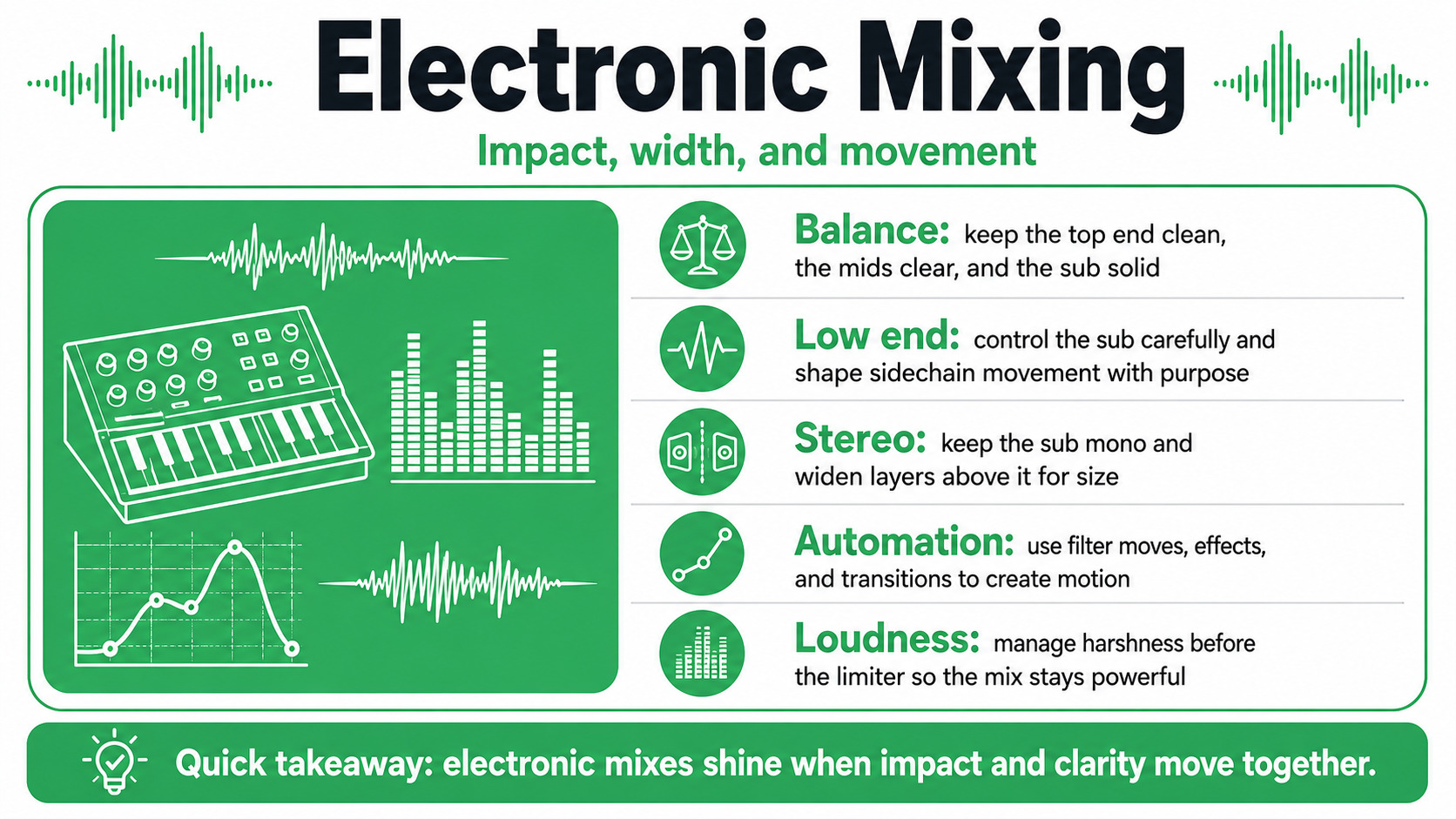
Electronic music still needs balance, of course, but it often rewards more obvious processing choices. Huge pads, layered synths, bass effects, and long reverb tails can turn into mud quickly if they are not shaped.
That is why electronic mixes often rely on deliberate ducking, filtered reverbs, tight low-end management, and automation that prevents repeating loops from feeling static. The production may contain fewer traditional instruments, but every layer can occupy a large amount of frequency and stereo space.
Stereo width also becomes more creative in electronic production than in many rock or classical mixes. Width can be automated between sections, and pads or effects can gradually spread outward to create movement.
At the same time, low frequencies are usually best kept in mono, especially below roughly 100 to 200 Hz. This avoids wasting side headroom and reduces phase problems on mono playback systems such as club sound systems. Wide synths are fun. Wide sub-bass is often a trap.
Electronic move examples
A good electronic mix often benefits from these habits:
- Keep sub information mono.
- Let width live in pads, FX, hats, delays, and upper harmonics.
- Shape long reverbs with pre-delay, EQ, and ducking.
- Use sidechain not just for loudness, but for groove and motion.
If your drop feels weak, the fix is not always more limiting. Sometimes the real issue is that the buildup already used too much width, too much top end, or too much density.
Electronic mixes feel big when contrast is planned. Narrowing the buildup, filtering the bass, reducing the drums, or simplifying the arrangement can make the drop feel larger without increasing its measured level. Save something for the payoff.
Genre specific mixing for classical and acoustic-first music
Classical mixing flips many modern habits on their head. Instead of creating a hyper-controlled close-up image, the goal is often to preserve a believable performance in a real acoustic space.
The recording stage is therefore especially important. Good microphone choice and placement can capture a balanced relationship between the instrument, performer, ensemble, and room before the mix even begins. When the source already feels complete, the mixer can work more gently and avoid rebuilding the performance through heavy processing.
Classical priorities are different on purpose
A live orchestra can cover an extremely wide range, with AES estimates approaching 100 dB between its quietest and loudest moments. That alone helps explain why aggressive compression can be a poor fit.
A classical mix usually needs dynamic control only when the recording medium, noise floor, or playback context demands it. The tension, scale, and contrast are part of the music. If you flatten those elements, you are not simply changing the mix. You are changing the emotional shape of the composition.
Stereo capture is also more important here than in many close-miked genres. A spaced pair can create a broad and open image, while coincident and near-coincident techniques often offer stronger localization and better mono compatibility. In classical work, microphone techniques frequently perform the role that plugins take on in modern pop production.
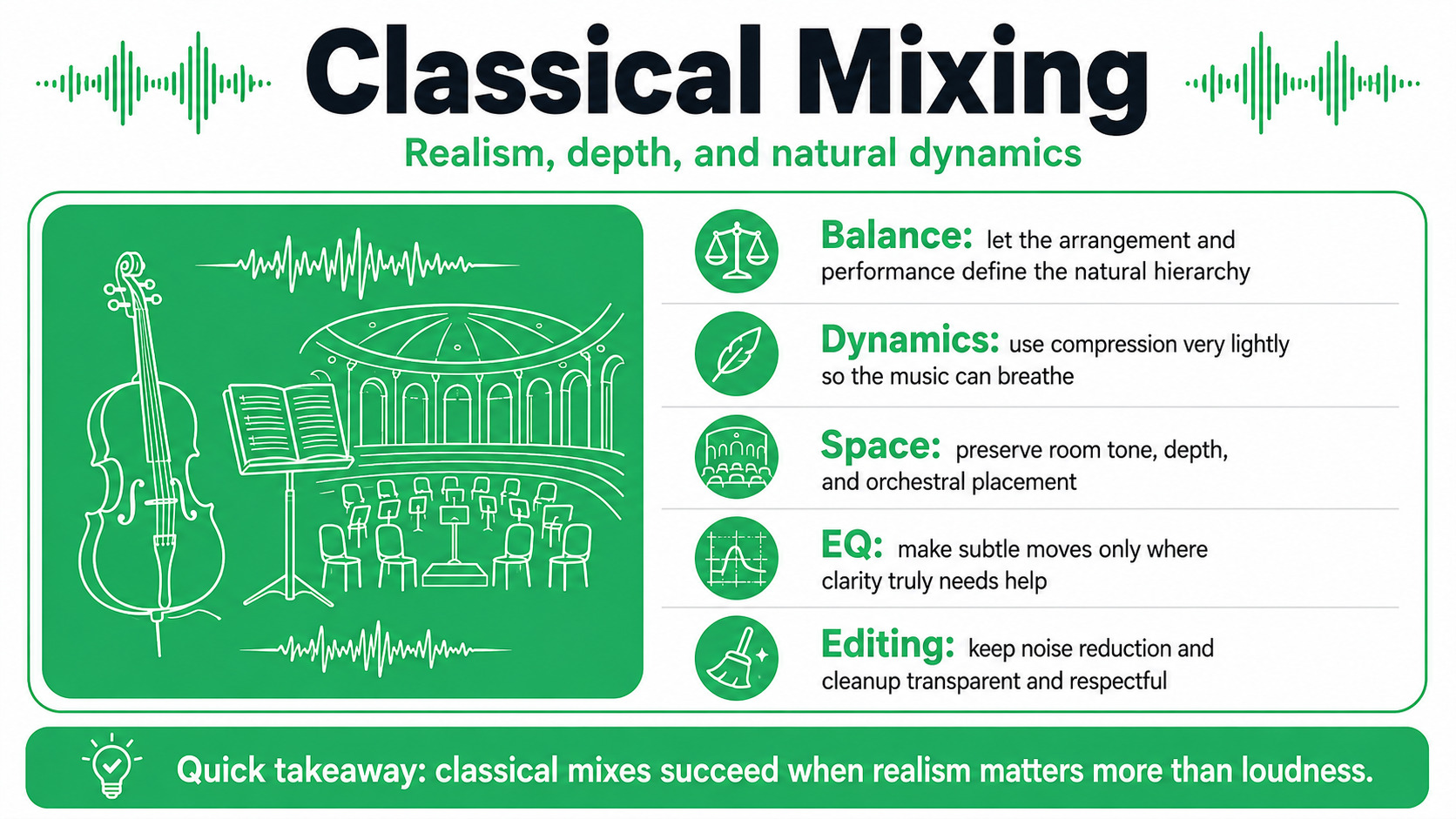
Classical move examples
Here is the mindset that usually works better in classical than a typical pop workflow:
- Get the room and microphone placement right first.
- Use EQ mainly for correction, not dramatic tone redesign.
- Compress only when there is a clear musical or delivery reason.
- Preserve depth, dynamics, and stereo perspective.
Distance matters a lot with acoustic instruments. Many instruments produce sound from several physical areas at once. A microphone placed too close may capture one mechanical or tonal detail while missing the complete sound that develops farther away.
That is why close-mic thinking can damage a classical recording. If you begin too close, you may spend the entire mix trying to recreate a natural image that better positioning could have provided automatically.
What not to do in classical
The biggest mistake is importing pop instincts without checking whether they belong. Heavy vocal-style de-essing on a soprano, exaggerated width on an orchestra, heavily limited peaks on a chamber recording, or oversized artificial reverbs can make the result feel less real and less moving.
Classical listeners usually want to hear the ensemble, the hall, and the conductor’s dynamic shape more than the mixer’s processing. The best classical processing often works quietly in the background, correcting distractions without drawing attention to itself.
How EQ, compression, reverb, stereo width, and loudness change across genres
This is where Genre Specific Mixing becomes very practical. The same core tools appear in every style, but their settings, intensity, and purpose change from genre to genre.
That is why plugin presets can be helpful for learning but risky as final answers. The better question is never “what is the correct compressor?” It is “what problem am I solving in this style?”
EQ and compression change the most
EQ is one of the most powerful tools in a mix. Cutting is often more effective than boosting when the goal is to create room for one sound around another. That mindset works across genres, but the target areas change.
Rock often needs low-mid cleanup and vocal-versus-guitar management. Hip-hop and electronic sessions often need careful kick-and-bass separation and controlled subs. Classical recordings usually need much less sculpting when the source was captured well.
A basic EQ frequency map can help while you train your ears. Sub-bass and kick weight often live around 50 to 75 Hz. The 80 to 200 Hz area can add warmth but can also become heavy or muddy. Much of an instrument’s body occupies roughly 200 to 500 Hz. Presence, definition, harshness, and sibilance become increasingly important as you move through approximately 2 to 10 kHz.
These are not rules. They are useful landmarks. The correct move still depends on the instrument, arrangement, recording, and genre.
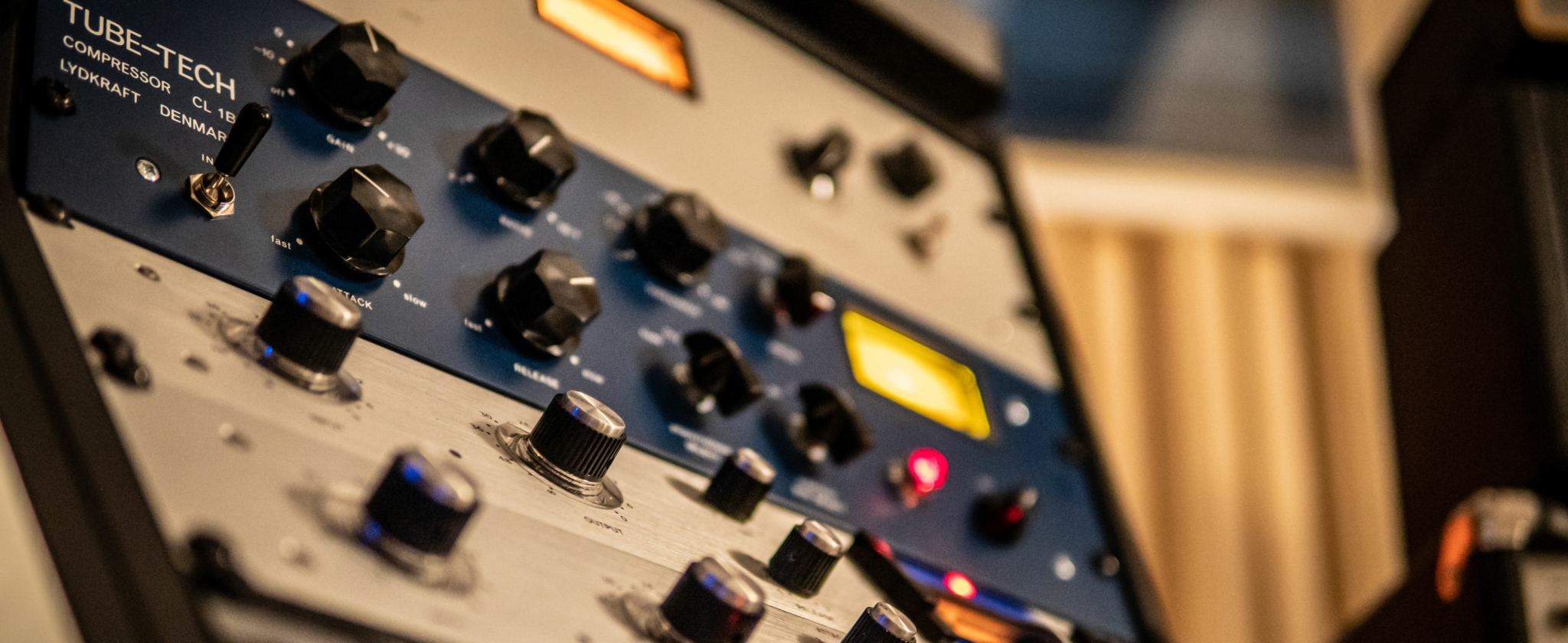
Compression also changes role depending on style. A rock bus compressor might be used to make the band feel more unified. A hip-hop vocal compressor may be responsible for consistency and forwardness. An electronic sidechain can create movement. A classical chain may barely compress at all.
The same tool can therefore have completely different job descriptions. Do not choose compression settings because they are considered normal for a genre. Choose them because they solve a specific musical problem.
Reverb, delay, and stereo field are genre markers
Reverb does more than create space. It tells the listener what kind of record they are hearing. More reverb usually makes a source feel farther away, which is a useful mental shortcut.
Rock often uses shorter ambiences and plates to stay punchy. Hip-hop may use tighter spaces on the lead vocal and more dramatic trails on ad-libs or transitions. Electronic production can use obviously artificial spaces, but those tails often need ducking or filtering to avoid mud. Classical music usually aims to preserve or subtly support a real acoustic environment rather than replace it.
Pre-delay is one of the easiest ways to retain clarity while still using an audible reverb. Delaying the start of the reverb gives the dry transient or consonant a moment to establish itself. This is especially useful in rock and electronic mixes where excitement matters but the front edge of the sound still needs to survive.
Shorter reverbs, controlled low frequencies on the return, and sensible pre-delay can also keep bass-heavy arrangements from smearing.
Stereo width is another area where genre changes taste quickly. Large ensembles can benefit from a broad image, while electronic productions may use exaggerated width as part of the sound design. However, low frequencies generally remain more stable in mono, and widening should never destroy mono compatibility.
Widen the elements that benefit from it, but do not let the center collapse. If your mix sounds impressive in stereo but weak in mono, it is not actually finished.
Loudness should follow delivery, not ego
This part matters more than ever. Spotify commonly uses a normal playback target of approximately -14 LUFS, adjusting playback gain rather than permanently rewriting the uploaded audio. The listener’s playback setting and device can affect the exact behavior, so the target should not be treated as a mastering command.
Apple Sound Check also reduces large volume differences between songs during playback. It does not mean every track must be mastered to one identical loudness value. It simply means that excessive limiting may not provide the playback advantage you expect.
For comparison, EBU R 128 uses -23 LUFS as its broadcast programme loudness target. When mastering for streaming we should consider the fact that online music and video platforms often operate at higher loudness levels than traditional broadcasting.
The practical takeaway is simple: smashing your mix harder and harder does not guarantee that it will play louder on streaming services. It may only reduce punch, contrast, and depth.
For rock, hip-hop, and electronic music, competitive loudness still matters emotionally, but translation matters more. For classical music, preserving dynamic range is often part of the product itself.
Instead of chasing one number for every style, think in terms of appropriate energy, crest factor, and platform translation. That is smarter than fighting normalization.
Common mistakes when mixing different genres
These mistakes appear constantly when people start Mixing Different Genres, because they are really habit problems disguised as equipment problems. The fix is usually to ask whether the move serves the style, not merely whether it sounds impressive in solo.
- Using the same vocal chain on every genre. A densely compressed rap vocal, a raspy rock lead, and a classical soloist usually need different balances of control, air, and ambience.
- Letting kick and bass fight instead of assigning roles. Masking in the low end is one of the fastest ways to lose punch.
- Making the sides exciting and forgetting the center. Width is great until mono playback hollows out your mix.
- Over-compressing acoustic or classical material. Wide dynamics are often a feature, not a flaw.
- Reaching for EQ before checking arrangement and panning. Faders, buses, and basic placement often solve more than beginners expect.
- Chasing loudness instead of translation. Playback normalization changes the reward system.
The advanced version of that same advice is this: every genre has a “too far” point. Rock can become too dense. Hip-hop can become too squashed. Electronic music can become too wide and too heavily pumped. Classical music can remain so untouched that genuine recording problems become distracting.
Great mixing is not about maximum processing. It is about choosing the right amount of control for the style in front of you.
Final thoughts on mixing different genres
The best engineers do not memorize one magic chain for every style. They learn what each genre usually values, then listen closely enough to know when the current song should follow those expectations or bend them.
That is the real skill behind Mixing Different Genres. Learn the shared fundamentals first. Then learn the genre priorities. Finally, trust your ears enough to adjust.
If you are a beginner, start by asking one question per mix: what should the listener feel first?
If you are more advanced, ask a second question: what should stay natural, and what should feel designed?
Those two questions will get you much further than copying presets. Rock wants impact. Hip-hop wants authority. Electronic music wants movement and control. Classical music wants truth, space, and dynamics.
Once you hear those priorities clearly, Genre Specific Mixing stops feeling complicated and starts feeling logical.
Sobre el autor

Dídac
CEO y Fundador de MasteringBOXDídac es un ingeniero de audio profesional, productor musical e ingeniero de software. También es el fundador de MasteringBOX y el autor de muchos de los artículos del blog.
Deja un comentario
Inicia sesión para comentar


 English
 Español
 Français
 Italiano
 Deutsch
 Português
 Nederlands
 Svenska
 Polski
 Čeština